Friday, March 29, 2013

Mater Dolorosa


Our Lady of Sorrows (Latin: Beata Maria Virgo Perdolens), the Sorrowful Mother or Mother of Sorrows (Latin: Mater Dolorosa, at times just Dolorosa), and Our Lady of the Seven Sorrows or Our Lady of the Seven Dolours are names by which the Blessed Virgin Mary is referred to in relation to sorrows in her life. As Mater Dolorosa, it is also a key subject for Marian art in the Catholic Church. The Seven Sorrows of Mary are a popular Roman Catholic devotion. There are devotional prayers which consist of meditation on her Seven Sorrows. Examples include the Servite rosary, or the Chaplet of the Seven Sorrows of Our Lady and the Seven Joys of Mary. The term "Sorrowful and Immaculate Heart of Mary" refers to the combined devotion of both the Immaculate Heart and the Seven Sorrows of Mary as first used by the Franciscan Tertiary Berthe Petit. Our Lady of Sorrows, depicted as "Mater Dolorosa" (Mother of Sorrows) has been the subject of some key works of Roman Catholic Marian art. Mater Dolorosa is one of the three common artistic representations of a sorrowful Virgin Mary, the other two being Stabat Mater (stood the mother) and Pietà. In this iconography, Our Lady of Seven Sorrows is at times simply represented in a sad and anguished mode by herself, her expression being that of tears and sadness. In other representations the Virgin Mary is depicted with seven swords in her heart, a reference to the prophecy of Simeon at the Presentation.

Jesus of Nazareth


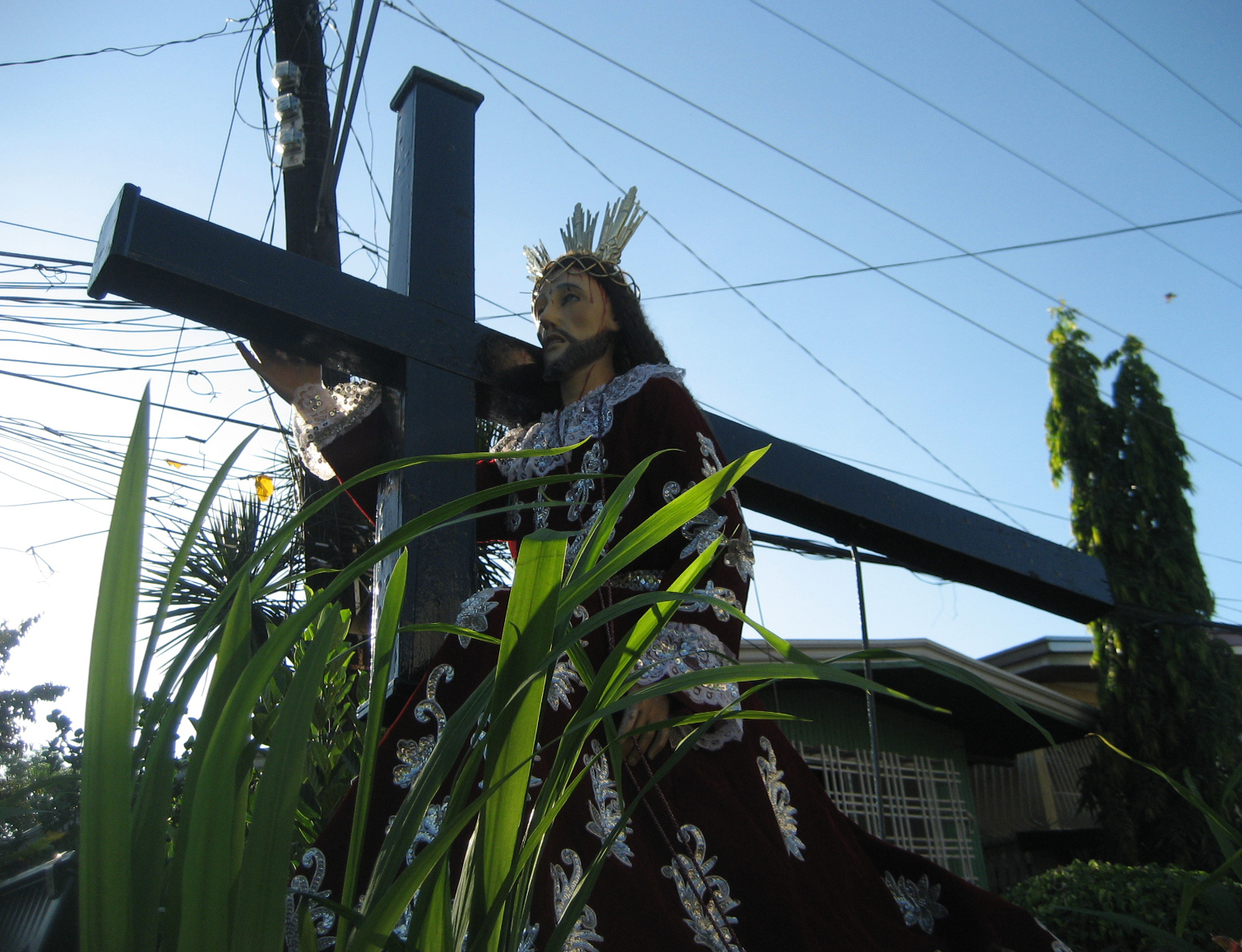
Christ Carrying the Cross on his way to his crucifixion is an episode included in all four Gospels, and a very common subject in art, especially in the fourteen Stations of the Cross, sets of which are now found in almost all Catholic churches. But the subject occurs in many other contexts, including single works and cycles of the Life of Christ or the Passion of Christ. Alternative names include the Procession to Calvary, Road to Calvary and Way to Calvary, Calvary or Golgotha being the site of the crucifixion outside Jerusalem. The actual route taken is defined as the Via Dolorosa in Jerusalem, although the specific path has varied over the centuries and continues to be the subject of debate. The episode is mentioned, without much detail, in all the canonical Gospels: Matthew 27:31–33, Mark 15:20–22, Luke 23:26–32 and John 19:16–18, and all but John include Simon of Cyrene, who was recruited by the soldiers to help carry the cross. Modern scholars, following descriptions of criminals carrying crossbars by Plautus and Plutarch, often take the Gospel description as meaning Jesus, then Simon, carried only a heavy patibulum, the crossbar, to a pole, stipes, which was permanently driven into the ground at Golgotha. However in Christian imagery Jesus, and Simon, carry the complete cross—both patibulum and stipes. Only Luke mentions the "women of Jerusalem", who were in later patristic writings and Christian art taken to include the Three Marys and the Virgin Mary. This meeting was usually located at the city gates, as in the painting illustrated, which is also typical in following Luke and showing Jesus turning his head to speak to them. The other episodes were later elaborations, with the Veil of Veronica appearing from the 13th century, and the falls of Christ, eventually three, first found in the Late Middle Ages. Luke mentions that the two thieves were also in the group walking out to Golgotha, but does not say that they had to carry their crosses, and though they may be identifiable among the walking figures, their crosses are very rarely anywhere to be seen in depictions of the group. Some works, like Raphael's Il Spasimo, Bruegel's Vienna Procession (see below for both), and the London Jacopo Bassano, have the thieves' two crosses already set up at the place of execution in the distant background. Also of relevance is Matthew 16:24, with which St Francis of Assisi began his first Rule of 1221: "Then Jesus said to his disciples, “Whoever wants to be my disciple must deny themselves and take up their cross and follow me". St Francis also used to be led with a cord around his neck as a pentiential exercise, the cord being a detail added to many depictions of the episode from two Old Testament passages. These are Isaiah 53:7: "He was oppressed and afflicted, yet he did not open his mouth; he was led like a lamb to the slaughter, and as a sheep before its shearers is silent, so he did not open his mouth" and Jeremiah 11:19 "I had been like a gentle lamb led to the slaughter...", both of which were very frequently cited by medieval commentaries. In medieval typology, Isaac carrying wood up the mountain for his sacrifice is the most common parallel for the episode, and often shown as a complementary scene; this scene is "Isaac Bearing the Faggots" (or "wood") in traditional art history terminology.

Saint John


John the Evangelist (יוחנן Standard Hebrew Yoḥanan, Tiberian Hebrew Yôḥānān meaning "Yahweh is gracious", Greek: Εὐαγγελιστής Ἰωάννης) (c. AD 1 – c. 100)[citation needed][dubious – discuss] is the conventional name for the author of the Gospel of John. Traditionally he has been identified with the author of the other Johannine works in the New Testament—the three Epistles of John and the Book of Revelation, written by a John of Patmos—as well as with John the Apostle and the Beloved Disciple mentioned in the Gospel of John. However, at least some of these connections have been debated since about 200. The Gospel of John refers to an unnamed "Beloved Disciple" of Jesus who bore witness to the gospel's message.The composer of the Gospel of John seemed interested in maintaining the internal anonymity of the author's identity. The apostle John was a historical figure, one of the "pillars" of the Jerusalem church after Jesus' death. Some scholars believe that John was martyred along with his brother (Acts 12:1-2), although many other scholars doubt this.Harris believes that the tradition that John lived to old age in Ephesus developed in the late 2nd century, although the tradition does appear in the last chapter of the gospel, though this debatable tradition assumes that John the Evangelist, John the Apostle, the Beloved Disciple mentioned in John 21 and sometimes also John the Presbyter are the same person. By the late 2nd century, the tradition was held by most Christians. According to a tradition mentioned by St. Jerome, in the second general persecution, in the year 95, St. John was apprehended by the proconsul of Asia and sent to Rome, where he was miraculously preserved from death when thrown into a cauldron of boiling oil. On account of this trial, the title of martyr is given him by the fathers. The tyrant Domitian banished St. John into the isle of Patmos. It was during this period that John experienced those heavenly visions which he recorded in the book of the Revelations in the year 96. Upon the death of Domitian John returned to Ephesus in 97. According to Alban Butler, some think he wrote his gospel in the isle of Patmos; but it is the more general opinion that he composed it after his return to Ephesus, about the year 98. St. John died in peace at Ephesus, in the third year of Trajan (as seems to be gathered from Eusebius's chronicle), that is, the year 100, the saint being then about ninety-four years old, according to St. Epiphanius and was buried on a mountain without the town.

Saint Filomena


Saint Nicodemus


Saint Nicodemus was a Pharisee and a member of the Sanhedrin, who, according to the Gospel of John, showed favour to Jesus. He appears three times: the first is when he visits Jesus one night to listen to his teachings (John 3:1–21); the second is when he states the law concerning the arrest of Jesus during the Feast of Unleavened Bread (John 7:45–51); and the last follows the Crucifixion, when he assists Joseph of Arimathea in preparing the corpse of Jesus for burial (John 19:39–42). The discussion with Jesus is the source of several common expressions of contemporary Christianity, specifically, the descriptive phrase born again used to describe the experience of believing in Jesus as Saviour, and John 3:16, a commonly quoted verse used to describe God's plan of salvation. An apocryphal work under his name — the Gospel of Nicodemus — was produced the mid-4th century, and is mostly a reworking of the earlier Acts of Pilate, which recounts the harrowing of Hell. Though there is no clear source of information about this Nicodemus outside the Gospel of John, the Jewish Encyclopedia and many Biblical historians have theorized that he is identical to Nicodemus ben Gurion, mentioned in the Talmud as a wealthy and popular holy man reputed to have had miraculous powers. Christian tradition asserts that Nicodemus was martyred sometime in the 1st century.

Saint Veronica


Saint Veronica or Berenice was a pious woman of Jerusalem. The "Acta Sanctorum" published by the Bollandists erroneously gave her Feast (under February 4), but the Jesuit Scholar Joseph Braun cited her commemoration in Festi Marianni on 13 January. Veronica was moved with pity when she saw Jesus carried his cross to Golgotha and gave him her veil that he might wipe his forehead. Jesus accepted the offering and after using it handed it back to her, the image of his face miraculously impressed upon it. There is no reference to the story of St Veronica and her veil in the canonical Gospels.She is known as the woman who wiped Jesus' face with her veil.Then the image of Jesus' face appeared on it. The closest is the miracle of the woman who was healed by touching the hem of Jesus’ garment (Luke 8:43–48); her name is later identified as Veronica by the apocryphal "Acts of Pilate". The story was later elaborated in the 11th century by adding that Christ gave her a portrait of himself on a cloth, with which she later cured the Emperor Tiberius. The linking of this with the bearing of the cross in the Passion, and the miraculous appearance of the image only occurs around 1380, in the internationally popular book Meditations on the life of Christ. The story of Veronica is celebrated in the sixth Station of the Cross. …According to the Catholic Encyclopedia, the name "Veronica" comes from the Latin vera, meaning "true" or "Truthful", and the Greek eikon, meaning "image"; the Veil of Veronica was therefore largely regarded in medieval times as the "true image", the truthful representation of Jesus, preceding the Shroud of Turin. Albrecht Dürer's 1513 Veronica (as he called it in his diary); its heraldic presentation with matched angelic supporters emphasizes the startling realism of the image. Saint Veronica was mentioned in the reported visions of Jesus by Sister Marie of St Peter, a Carmelite nun who lived in Tours, France, and started the devotion to the Holy Face of Jesus. In 1844, Sister Marie reported that in a vision, she saw Saint Veronica wiping away the spit and mud from the face of Jesus with her veil on the way to Calvary. She said that sacrilegious and blasphemous acts today are adding to the spit and mud that Saint Veronica wiped away that day. According to Sr Marie of St Peter, in her visions Jesus told her that He desired devotion to His Holy Face in reparation for sacrilege and blasphemy. Acts of Reparation to Jesus Christ are thus compared to Saint Veronica wiping the face of Jesus. The Devotion to the Holy Face of Jesus was eventually approved by Pope Leo XIII in 1885. St Veronica is commemorated on 12 July.

Saint Salome


Salome (Hebrew, "שלומית", "Shelomit"), was a follower of Jesus who appears briefly in the canonical gospels and in more detail in apocryphal writings. She is sometimes identified as the wife of Zebedee, the mother of James and John, two of the Apostles of Jesus, and sometimes also as the sister of Mary, mother of Jesus. In Roman Catholic tradition Salome is identified with Mary, mother of James and counted as Mary Salome among the Three Marys. In Mark 15:40, Salome is named as one of the women present at the crucifixion: "There were also women looking on afar off: among whom was Mary Magdalene, and Mary the mother of James the less and of Joses, and Salome". The parallel passage of Matthew (27:56) reads thus: "Among which was Mary Magdalene, and Mary the mother of James and Joses, and the mother of Zebedee's children." The Catholic Encyclopedia (1913) concludes that the Salome of Mark 15:40 is probably identical with the mother of the sons of Zebedee in Matthew; the latter is also mentioned in Matthew 20:20, in which she petitions Jesus to let her sons sit with him in Paradise. In John, three or perhaps four women are mentioned at the crucifixion; this time they are named as "his [Jesus'] mother, and his mother's sister, Mary the wife of Cleophas, and Mary Magdalene." A common interpretation is to identify Salome as the sister-in-law of Jesus' mother, thus making her Jesus' aunt. Traditional interpretations associate Mary wife of Clophas (the third woman in the Gospel of John) with Mary the mother of James son of Alphaeus (the third woman in the Gospel of Matthew). In the Gospel of Mark, Salome is among the women who went to Jesus' tomb to anoint his body with spices. They discovered that the stone had been rolled away, and a figure in white then told them that Jesus had risen, and asked them to tell Jesus' disciples that he would meet them in Galilee. In Matthew, just two women are mentioned in the same story: Mary Magdalene and the "other Mary" - Mary the mother of James son of Alphaeus. The canonical gospels never go so far as to label Salome a "disciple" ("pupil" mathētēs), and so mainstream Christian writers usually describe her as a "follower" of Jesus per references to the women who "followed" and "ministered" to Jesus (Mk 15:41).