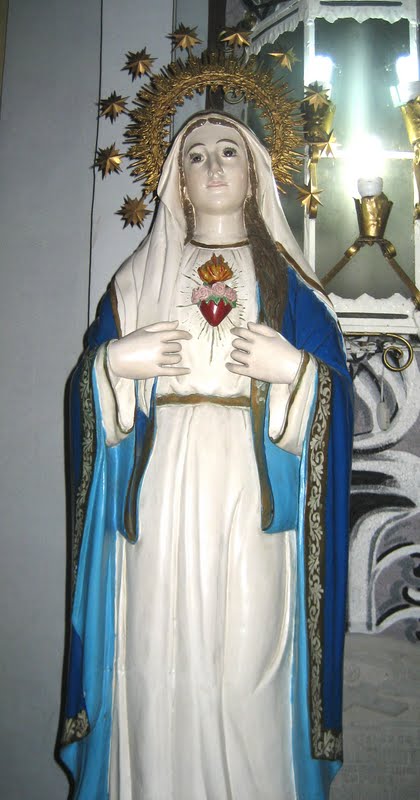
This is my Mysterium Tremendum. Images of the Divine and Holy Saints have filled my life with inspiration and reminders to do the the Holy Will of God. In my silent and small ways, I respond to this vocation...if only I could show how much I love God.
Thursday, September 8, 2011
Sto. Cristo Del Perdon
On November 23, 1954, a new decree of the Crusade was issued-from Crusade of Charity and Goodwill, it was renamed to Crusade of Penance and Charity. The image of the Santo Cristo del Perdon was added to accompany the procession to inspire repentance of sins and renewal of life among the people. Seven Caballeros de Cristo were appointed. Processions of the Crusade were accompanied by seven symbolical lanterns. The Caballeros de Cristo took turns in carrying the image of the Crucified Christ. Number seven was again chosen by the Bishop to signify the seven Archangels who adore the Triune God.
Virhen de los Remedios
The Virgin of Los Remedios (Spanish: La Virgen de los Remedios) or Our Lady of Los Remedios (Spanish: Nuestra Señora de los Remedios) is a small statue of the Virgin Mary, believed to have been brought to Mexico by the conquistadores. She is a small image of the Virgin Mary, measuring 27 cm in height. This image is strongly linked with the Spanish Conquest, especially the episode known as the “Noche Triste” or Sad Night. It is said Cortés led his men to an indigenous religious sanctuary to escape the Aztecs, stopping here on their way to Otumba. According to legend, one of Cortés’ soldiers, Gonzalo Rodríguez de Villafuerte, was carrying a small image of the Virgin Mary and hid her under one of the maguey plants in order to retrieve and pay homage to her later if he survived. During a later battle in this area, the Spanish reported seeing a young girl throwing dirt into the eyes of the Aztecs to help the Spanish. Another legend states that this image appeared at the Cerro de los Pajaros, where a chapel was built in 1574, which later was expanded in 1628 with a vaulted roof and cupola. Being connected with the Conquest, this image of the Virgin is considered to be “Spanish” and a patroness to them and to the indigenous who adopt Spanish ways. She is considered one of the Virgins who correlate with the four cardinal directions (in her case, the west), along with the Virgins of Guadalupe, of la Piedad and de la Bala.
Despite her importance to the area, this image was kept at the Mexico City Cathedral until 1810. In that year, it was moved to her sanctuary in Naucalpan, dressed as a general. It was proclaimed as a patroness of Spain and the “guardian of the Spanish Army.” The purpose of this was to counter Miguel Hidalgo’s use of the Virgin of Guadalupe as a symbol of his independence movement.
This image was center of one of the first annual processions to be held in Mexico, which went from the Church of Santa Veracruz in Mexico City to her home sanctuary in Los Remedios National Park. It's feast day is still celebrated on September 1, On this day, the sanctuary is profusely decorated with white flowers, which includes a carpet of flower petals in the San Miguel Arcangel esplanade. This sanctuary is not located in the city proper, but in the mountainous western part of the municipality where the Los Remedios National Park stands. Her feast day is celebrated with dances knowns as “Los Apaches,” “Los Moros,” “Chichimecas” and “Pastorcitas,” with 450th anniversary of her finding celebrated in 1990.
Philippine Tradition
Pampanga was a hotbed of socialism and Huk insurgency in the 50s. So, to temper these 'godless ideologies', Bishop Cesar Ma. Guerrero of the new Diocese of San Fernando launched the Cruzada ning Pamanisi at Lugud (Crusade of Penance and Charity) .
“Aqui en Pampanga hay mucha piedad, pero poca caridad! (Here in Pampanga, there is much piety but little charity!)” the Bishop noted.The symbol of the crusade revolved around a small image of a Virgin from Baliti; she was borrowed and titled Virgen de los Remedios. Thus, the tradition of religious processions and acts of charity (lamac) began. Virgen de los Remedios made the rounds of Pampanga towns for a full year, and the towns took turns hosting the image. The devotion touched lives, healed wounds, converted people and helped stem the tide of Communism.
In the next year of the Cruzada however, the people of Baliti, due to some misinformation, refused to loan out their Virgin, to the disappointment of the Bishop. Emotions ran high in Baliti, with threats that "blood will flow" if the Virgin is taken forcibly from them. Bishop Guerrero thus had a second image made, a taller version of the original Baliti Virgin--and this was the image that was canonically crowned in 1956. Eventually, two more replicas were made of the image, for use in the northern and southern Pampanga towns. The 'Coronada' Virgin now remains in the Chancery, while the Baliti Virgin has its own shrine. At one point, Baliti had to suffer the stigma of being a town of selfish and possessive people, and as a result, the crowned duplicate at the Chancery is looked at and recognized as the real Patroness of Pampanga.
Immaculate Heart of Mary
The feast of the Immaculate Heart of Mary is related to the festival of the previous day, the Sacred Heart of Jesus. As we celebrate the love of God in the heart of his Son, Jesus, we celebrate today the perfect response of a human being to this love, the response of Mary.
In the Catholic understanding, Mary represents the most complete response of a human being to the Creator. This is summed up in her words to the angel Gabriel, “I am the Lord’s handmaid. May it be done to me as he wishes.” In other words, Mary’s attitude is obedience, surrender of her will to God’s.
Another aspect of Mary’s character is the attribute “immaculate” — without stain of sin. The word ‘immaculate’ usually connotes purity, virginity, a chaste and complete dedication, an undivided heart – a heart not distracted by earthly temptations.
That’s what Mary was – completely dedicated and focused on the Lord.
When we contemplate the life of Mary as told us in the Gospels, we are astonished at how closely she related to the mission of her son, Jesus, even though at many times it was not be entirely clear to her what it was. This is why Luke writes of her, “Mary stored all these things up in her heart, and pondered over what they might mean.”
From the moment she committed herself to the Lord’s plans for her at the Annunciation, to her final steadfastness under the cross at Calvary, she did not waver a bit from her commitment. Her heart remained ‘immaculate,’ freed from any distraction to disobedience, denial or waywardness. Our hearts, our desires tend to run away so easily. Not Mary’s, never Mary’s.
If the feast of the Sacred Heart celebrates God’s total love for us, its complementary feast, that of the Immaculate Heart tells us what our response to God’s love should be!
Inang Poong Bato
Our Lady of Ina Poonbato (Botolan, Zambala, Philippines) became popular after the explosion of Mt.Pinatubo in June 1991 when it was half buried in lava. The image of Ina Poonbato is said to be of miraculous character.
The statue was found by the Aeta chief Djadig over four hundred years ago. He brought the beautiful lady carved in shining wood to this home. His wife threw the statue--without recognizing its meaning--into the fire. The fire burned the house down but left the statue unscathed. It soon became an object of veneration among the Aetas. The first missionaries to the Zambalas region (1608, Recoletos) recognized the statue as that of Our Lady and transferred it to their church. During the Philippine revolution, patriots-rebels took the image to their church, the Philippine Independent Church. A replica, made by Maximo Vicente, sculptor, in 1976, became a traveling Madonna. Beginning in 1981 the Ina Poonbato has been to nearly all dioceses in the Philippines. In Rome, it was blessed by John Paul II.
Two things may be remembered especially. When Djadig discovered the "lady carved in shining wood," he heard a voice telling him, "Djadig, Djadig, take me home with you." The call of Mary goes to the heart of all of us: "Take me home with you." The Recoleto missionaries first thought they had to deal with anito worship. But when they saw the image, they knew better. They were convinced, "She must have paved the way for our coming."
For more information call 63-917-621-2332 or write to Rosellyn Magsaysay, Ina Poonbato Foundation, 33 Marikit Street, West Triangle Homes, QC, Philippines.
Mary Magdalene
Immaculate Conception
The Feast of the Immaculate Conception celebrates belief in the Immaculate Conception of the Blessed Virgin Mary. It is celebrated on 8 December, nine months before the Nativity of Mary, which is celebrated on 8 September. It is the patronal feast day of the United States and the Republic of the Philippines. It is celebrated by the Roman Catholic Church as well as a few other closely related Christian churches.
The Eastern Christian Church first celebrated a feast of the Conception of the Most Holy and All Pure Mother of God on December 9 perhaps as early as the 5th century in Syria. By the 7th century it was already a widely known feast in the East. In the same century the idea of Mary's spotlessness was adopted by Islam and is included in the Qur'an. However, when the Eastern Church called Mary achrantos (spotless or immaculate), it did not define exactly what this meant. Today the majority of Orthodox Christians would not accept the Scholastic definition of Mary's preservation from original sin before her birth that subsequently evolved in the Western Church after the Great Schism of 1054. After the feast was translated to the Western Church in the eighth century, it began to be celebrated on December 8th. It spread from the Byzantine area of Southern Italy to Normandy during the period of Norman dominance over southern Italy. From there it spread into England, France, Germany, and eventually Rome.
Prior to Pope Pius IX's definition of the Immaculate Conception as a Roman Catholic dogma in 1854, most missals referred to it as the Feast of the Conception of the Blessed Virgin Mary. The festal texts of this period focused more on the action of her conception than on the theological question of her preservation from original sin. A missal published in England in 1806 indicates the same collect for the feast of the Nativity of the Blessed Virgin Mary was used for this feast as well.
The first move towards describing Mary's conception as "immaculate" came in the eleventh century. In the fifteenth century Pope Sixtus IV, while promoting the festival, explicitly tolerated those who promoted it as the Immaculate Conception and those who challenged such a description, a position later endorsed by the Council of Trent.
The proper for the feast of the Conception of the Blessed Virgin Mary in the Medieval Sarum Missal, perhaps the most famous in England, merely addresses the action of her conception.
The collect for the feast reads:
O God, mercifully hear the supplication of thy servants who are assembled together on the Conception of the Virgin Mother of God, may at her intercession be delivered by Thee from dangers which beset us.
In 1854, Pius IX made the infallible statement Ineffabilis Deus: "The most Blessed Virgin Mary, in the first instant of her conception, by a singular grace and privilege granted by almighty God, in view of the merits of Jesus Christ, the saviour of the human race, was preserved free from all stain of original sin."
Virgen de Barangay
VIRGEN DE BARANGAY, Feastday March 1
A barangay is the smallest local government unit in the Philippines and is very similar to a village or a town. Municipalities and cities are composed of barangays.
Each barangay is headed by a barangay captain (punong barangay) who leads the barangay council (sangguniang barangay) composed of barangay councilors (kagawad). Every barangay also has a Sangguniang Kabataan (SK) (Youth council), composed of the SK President or Chairman and SK Councilors, who direct the youth-oriented activities, such as basketball leagues, in the barangay.
Historically, the term barangay refers to a community of around 50 to 100 families. The word itself comes from the Malay balangay which means “boat.” This connection between community and boat supports theories on the history of the pre-colonial Philippines, that being, each original coastal “barangay” formed as a result of a single or a group of settlers arriving by boat from other places in Southeast Asia.
In 1954, Antonio Gaston had a word with Bishop Manuel Yap about the idea of giving the patroness of the Barangay sang Birhen Organization a purely Filipino look. Bishop Yap approved the idea, but suggested that the image, however, should give an impression of Jewishness.
Getting such ikon painted proved to be a problem. Initial efforts of artists from the Salesian order, as well as by graduates from prestigious art schools are not completely satisfactory. Several months later, Father Pixner sent
Gaston a painting done by Crisogono Domingo, an inmate of Santa Barbara Leprosarium, not on a canvass but on a lawanit board. One look at the painting and Gaston knew the Barangay had a true picture of its patroness. The ikon of the Virgin of the Barangay likewise gained enthusiastic approval of Bishop Manuel Yap, and was canonically blessed and installed in the diocese by October 16, 1954.
June 12, 1975, the original painting of the image of the Barangay sang Birhen arrived in the Diocese of Tagbilaran for her visitation; she was brought by the Regional Datu of Davao, Lakan Olibo and his companions. Her visitation from Parish to Parish, to the remotest Barrios or Barangay, lasted for almost 6 years and 15 days. The Last Parish visited was Sikatuna. From Sikatuna, she was brought to Ilihan Hill Chapel in Jagna, Bohol starting February 3, 1979 up to January 12, 1981.
On January 14, 1981, the original painting was brought back to Bacolod City for the historical visit of the Holy Father where the image of the Virgin was personally blessed by His Holiness, Pope John Paul II on February 20, 1981, Bishop’s Palace, Bacolod City
Subscribe to:
Posts (Atom)